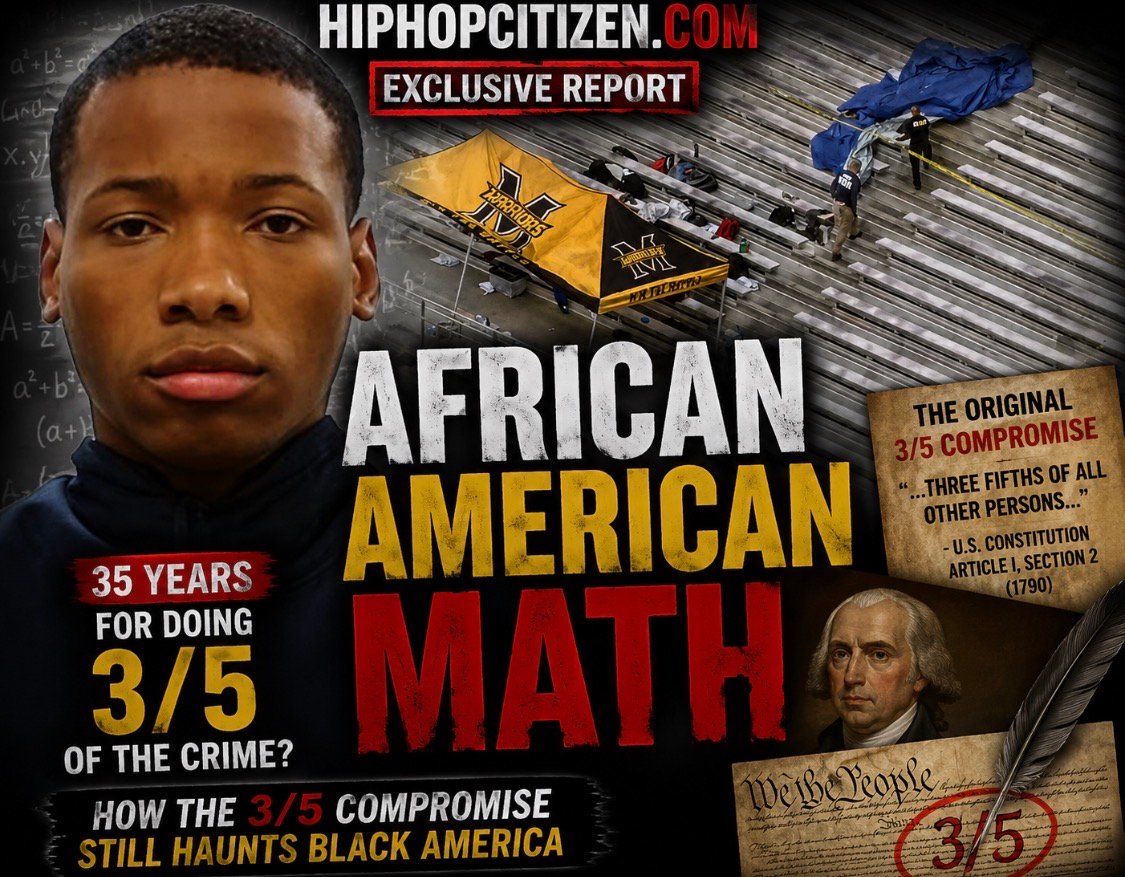
There is a clause in the original United States Constitution — Article I, Section 2, Paragraph 3 — that assigned enslaved Black people a mathematical value. Not as human beings. As a political unit. The value was three-fifths. Today, on June 9, 2026, a jury in Collin County, Texas sentenced Karmelo Anthony — a Black teenager who was 17 years old when the crime occurred — to 35 years in prison. The jury deliberated two and a half hours on the sentence. These two facts are separated by 239 years. The logic connecting them is not.
"Representatives and direct Taxes shall be apportioned among the several States...which shall be determined by adding to the whole Number of free Persons...and three fifths of all other Persons."
"All other Persons" = enslaved Black people. Primary source: National Archives, Washington D.C.What the Compromise Was Actually About
The Three-Fifths Compromise was not a moral debate about humanity. Everyone in that Philadelphia room in 1787 already knew what they thought about that. It was a power calculation. Southern states wanted to count their enslaved populations for congressional representation — maximizing their political power — without granting those people any rights whatsoever. Northern delegates resisted. The deal they cut was three-fifths: every enslaved person counted as 60% of a human being for the purpose of determining how many votes a state received in Congress. The people whose bodies were being calculated were not in the room. They were the subject of the negotiation — the way a livestock price negotiation involves the animal without including it.
They wanted the political benefit of Black bodies
without the obligation of Black humanity.
The Fraction That Never Really Left
The Three-Fifths Clause was removed from constitutional law by the 14th Amendment in 1868 — 81 years after it was written. But removing language from a document does not dismantle the infrastructure that language built. The congressional districts, the Electoral College math, the wealth gaps, the school funding disparities, the incarceration rates — all carry the inertia of a system that was designed from its founding document forward to undercount and undervalue Black political and economic life. The numbers tell the story.
Hip hop was born in the South Bronx in 1973 — one of the most economically abandoned urban neighborhoods in America, abandoned through deliberate policy decisions downstream of the political power structures the Three-Fifths Compromise helped create. When Grandmaster Flash rapped about broken glass and the bill collector, he was documenting the lived consequences of a founding document that built a system designed to keep his community undercounted. Every verse since has been a recount. Every stage is a full person standing where the document said less.
35 Years in Two and a Half Hours
On April 2, 2025, Karmelo Anthony — then 17 years old — stabbed Austin Metcalf, also 17, during a confrontation at a Frisco ISD track meet outside Dallas. Metcalf died. Anthony was arrested and charged with first-degree murder. The defense argued self-defense — that Metcalf's team had disputed Anthony's right to shelter in their tent on a rainy day, that a physical confrontation ensued, and that Anthony acted in a split-second moment of fear. Surveillance footage from the stadium did not capture the stabbing. Anthony did not testify. His mother took the stand during sentencing, told the jury he was her firstborn and that he was deeply sorry. The jury deliberated several days on guilt. They returned a murder conviction. Then, in two and a half hours, they returned a sentence of 35 years.
Age at offense: 17. Sentencing range: 5 to 99 years. Sentence received: 35 years. Parole eligible after serving half. Jury deliberation on sentence: 2.5 hours. Race of defendant: Black. Race of victim: white. Location: Collin County — one of the most conservative counties in Texas.
Sources: CBS Texas, Fox 4 Dallas, ABC News, CNN, AP — June 9, 2026A 17-year-old. A range of 5 to 99 years.
They chose 35. In two and a half hours.
The Parallel the Culture Is Sitting With Tonight
The case split the country along racial lines before the verdict was delivered. Anthony is Black; Metcalf was white. Lawyers on both sides told jurors the tragedy had nothing to do with race. But the public processed it almost entirely through race — two parallel universes of response, each one certain of its own reading. In one universe, 35 years was justice for a life cut short. In the other, 35 years was an egregious sentence for a minor in a self-defense dispute — handed down in 150 minutes, in one of the whitest conservative counties in Texas, for a stabbing that no camera captured.
The Three-Fifths Compromise was not emotional. It was actuarial. It said: we have assigned a number to the value of your presence in our system, and that number is less than one. The 35-year sentence is not three-fifths. But the logic that produced it — the ease with which a system assigns a very long number to a very young Black life, the speed with which a jury reaches that number, the county in which that number is reached — feels continuous with the logic of 1787. The names change. The arithmetic updates. The underlying calculation does not. One question for the culture tonight: at what point does a pattern become a policy?
DonJuanDMack is the Editor of HipHopCitizen.com. Constitutional sources: The Constitution of the United States (1788), Article I, Section 2, Paragraph 3; 14th Amendment (1868); National Archives. Karmelo Anthony case sources: CBS Texas, Fox 4 Dallas, ABC News, CNN, AP, NewsNation (June 9, 2026). All facts are based on publicly available trial reporting. This article presents the sentencing as a matter of public debate and does not assert a legal position on guilt or innocence.
Three-Fifths. Thirty-Five Years. Same Math? Tell Us.
A founding document that assigned Black people a fraction. A 2026 jury that assigned a Black teenager 35 years in 150 minutes. Is this history repeating — or is the math exactly the same as it's always been? Drop your take below.